
The Community Science Lab - sites of activity (2)
glyncoch, nr pontypridd, South Wales
Case study:
From the late 1880s, the mining of Pennant Stone - sandstone valued chiefly for the grip it adds to road surfaces - has been permitted by successive local authorities at the Craig Yr Hesg quarry in Glyncoch on the northern edge of Pontypridd. In terms of sustainability, when measured by life cycle assessment (LCA), sandstone quarrying adds to climate change and, without more recycling/substitution, depletes fixed resources.
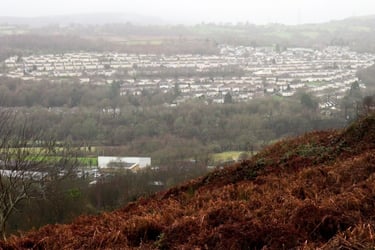
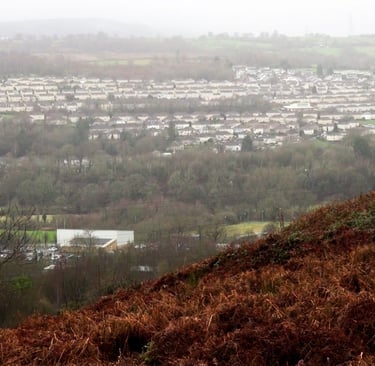
The quarrying site is close to existing housing (<200 metres away) which is down wind from prevailing south-westerly winds. Glyncoch is an area of publicly- and privately-owned council housing built from the early 1960s on the rural fringes north of Pontypridd. It has always scored poorly in terms of multiple deprivation in Wales (see, for example, WIMD 2019). Residents, some of whom draw on place-based narratives rural decline and who seek greater environmental rights as citizens - their collective expertise is largely ignored by the regulatory authorities - can recall local farmland and woods, and the associated biodiversity, becoming progressively reduced from the 1960s to the present due to the expansion of the quarry.
In 2017, the UK-based leaseholder, Hanson, bought the land from RCT having first suggested the transfer in 2014. An application was then made to extend the life of the quarry beyond a 2022 limit to 2028 (since 2007, Hanson has been owned by a German aggregates firm, the Heidelberg Cement Group). Current and former residents formed an anti-quarrying action group, Save Craig Yr Hesg Mountain. There are distinct economic, social and environmental concerns about the governance of the Craig Yr Hesg quarry extension which Glyncoch residents - and people more widely in Pontypridd - want addressing. Some have turned to 'community science' (cf. Evans et al, 2023) to help find answers.
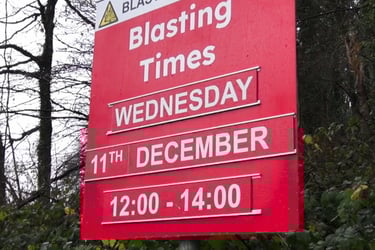
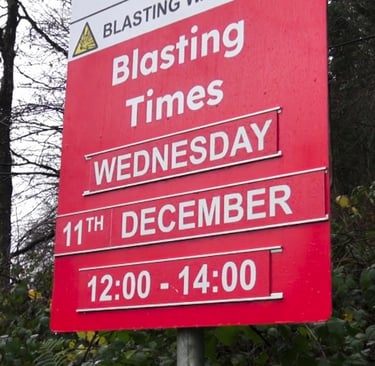
RCT refused planning permission in 2021, but Heidelberg appealed successfully to the Planning and Environment Inspectorate Wales (PEDW) in 2022. The Welsh Government then gave planning permission to extend the quarry. Heidelberg has indicated 2047 is now the quarry's reclamation date. Some members of the protest group have been undertaking community science and citizen science activity - chiefly monitoring the air quality, the numbers of HGVs, cracks in people's houses and noise levels - as well as peaceful street protesting (see, for example, ITV Wales' coverage and Byline Cymru's coverage).
There appear to be particular mental and physical health impacts on the community whose members, until recently, believed that the quarrying would finally stop in 2022. Anecdotal evidence from the area also includes the increased incidence of asthma and certain cancers plus heart, lung and kidney problems which residents fear could be associated with long-term exposure to silica dust (i.e. these exposures at whatever levels may have been cumulatively impacting upon other known individual exposures to tobacco smoke and exhaust fumes, for example). Nevertheless, in the face of calls by the statutory health authorities for stricter health impact assessment (HIA) in Hanson's 2021 Environmental Statement (see Non-Technical Summary), the developer and PEDW in 2022 claim that such concerns are unfounded. The latter's opinion, in particular, is that the risks associated with quarrying at Craig Yr Hesg can be managed perfectly safely until 2047.
Starting in mid 2024, Cardiff University's School of Geography and Planning was invited to begin documenting the planning history and citizen science occurring at the site.
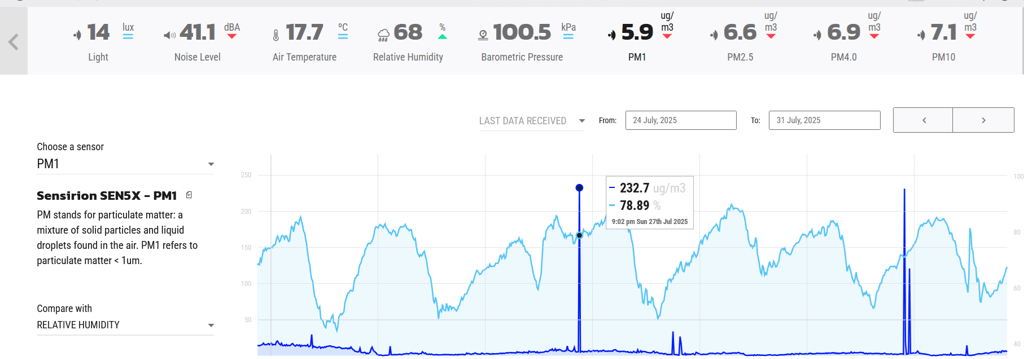
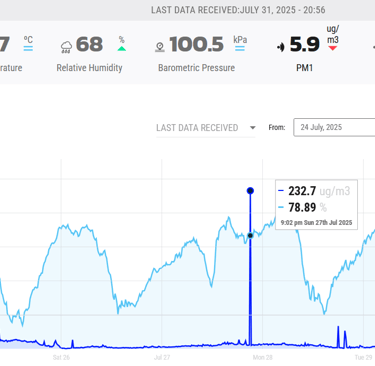
In July 2025, two SmartCitizen air quality monitors from FabLabBarcelona were added to the community's pre-existing monitoring kits thanks to impact funding from the School of Geography and Planning. Environmental monitoring data streams from Monitor #1 and Monitor #2 include airborne particulate matter (PM) down to PM1 or 1 micron or less in diameter (much thinner than a human hair). As this baseline data builds up over the next 12 months and beyond, schools, colleges and residents in the local area will be encouraged to log in and download the data files of readings which can be turned into charts and graphs. These may or may not capture localised noise and emissions after blasting events. Some community members are prepared to 'trust', so long as they can independently 'verify'...
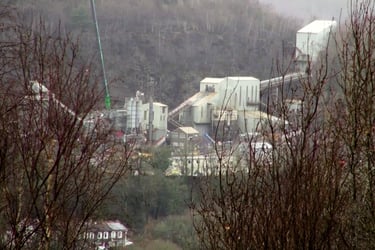
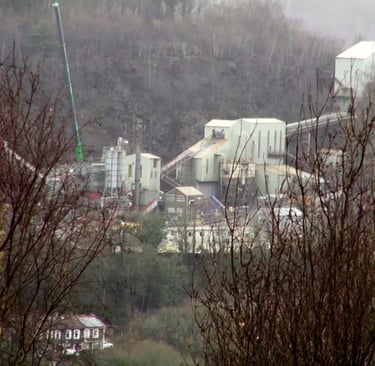
© Nick Hacking
© Nick Hacking
© Nick Hacking
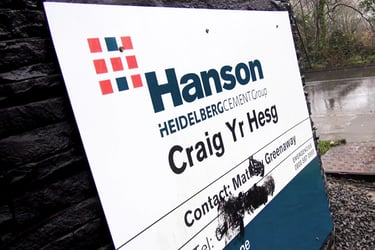
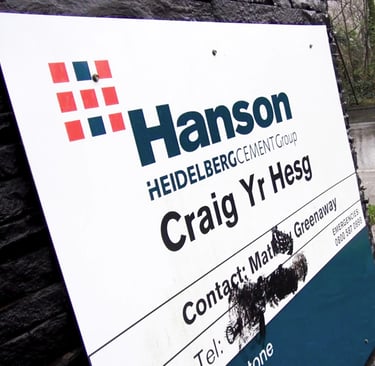
© Nick Hacking
Monitors currently available:
1) Rhondda Cynon Taf County Borough Council environmental monitoring equipment at Garth Avenue, Glyncoch - Monitor #1 - including airborne particulate matter (PM) readings down to <PM2.5 and <PM10. This site is near to the crusher operations.
2) Community-funded Purple Air environmental monitoring equipment at Conway Close (the rugby ground which is closest to the open quarry), Garth Avenue and Cefn Lane (at the same height as the quarry entrance) - Monitors #2, #3 and #4 - respectively, covering PM readings at <PM2.5.
3) Cardiff University-funded SmartCitizen platform environmental monitoring data streams at Garth Avenue in Glyncoch - Monitor #5 - and Greenfield Avenue -Monitor #6 - including airborne particulate matter (PM) readings at <PM1, <PM2.5, <PM4, <PM10 and average particle size.
Media available:
Link to photographer Mark Griffiths' 15-minute film, Hollow Mountain, launched in November, 2025. The film explores the effects of quarry blasting, silica dust, and the steady loss of green space surrounding the community of Glyncoch in South Wales. It raises urgent questions about harmful decisions made by those in power, and the lasting consequences for both the fragile landscape and the people living in its shadow.